

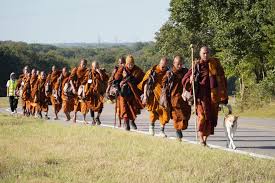
The Walk for Peace, by the Buddhist monks from Fort Worth Texas to Washington D.C. has been in the news everywhere. Now that it has concluded, I hope that people will remember it, and what it stood for. Before I go on, I’d like to post a disclaimer: I am not a professional, or an expert on anything I write. What I write here and in every article you see on this blog is my own opinion and nothing more.
In at least a few (I have not seen all of the videos) talks that the monks gave along the walk, Venerable Bhikkhu Pannakara, talked about mindfulness. Many people may not know what mindfulness is, and of course it can be looked up on the internet, but I thought I’d put in my own interpretation here. Mindfulness is a concept that comes from the Hindu religion, then was adapted as a central facet of Buddhism. From there the idea was taken out of Buddhism and made popular by Dr. Jon Kabat-Zinn in 1979. However it didn’t become mainstream until the 2010’s. Since that time, mindfulness has become a popular practice within the corporate world as a way to relieve stress and anxiety. It is a practice that anyone can do but I’ll be honest here, it’s not easy. It is something that takes time and effort to do well, and unless you’re a monk in a monastery, it’s hard to perfect. That being said, with a little effort we can all learn how to practice mindfulness. And for me, it helped a great deal.
So what is it? Very simply, mindfulness is keeping your attention on the here and now. That’s it, that’s all there is too it. It’s not some mystical practice that takes a belief in something beyond yourself, it doesn’t take equipment or ritual or anything else. It just involves you and your mind. All you have to do is pay attention. Earlier I said it isn’t easy, and you will find that’s true when you try it.
So here goes. Fing a quiet place with no distractions. Sit in a chair, preferably a straight back chair (you don’t want to be too comfortable, or you might fall asleep) and pay attention to your breath. Focus on it. Feel your breath going into and out of your nostrils. Feel your lungs inflate and deflate. That’s all. See how long you can do it before your mind wanders to something else. If you’re like me, it took about 10 seconds before I started thinking about something else. I’ve got an itch on my arm. Oh, I forgot to get milk at the grocery store. I forgot to mail that letter. I hope Joe didn’t take what I said wrong. You get the idea. Thoughts come flooding in like a tidal wave, especially when we want to keep them out. Many people get discouraged quickly because of this. What we need to realize is that we’re learning something new here, a new skill, and it’s rare for anyone to be really good at something the first time. It takes time and effort to get good at mindfulness. If you keep practicing, after a while you can get good at it and do it well.
Now, you may ask, what’s the reason for doing it at all? Simply put if you’re thinking about your breath, you’re not thinking about anything else, and anything that keeps us from worrying about all the stuff in our lives is a good thing, right. To sit and do nothing but breathe is relaxing and ultimately stress reducing. There have been lots of studies done about stress reduction and how important it is to our health. Congratulations, you’re doing mindfulness meditation.
Now, let’s move on to something else. You can also practice mindfulness anytime during your day. Sitting in a chair paying attention to your breath is good but many people don’t have a lot of time. So what can we do about that? Well, I’ll tell you. You can practice mindfulness when you’re doing all kinds of activities. Try this: Wash your dishes by hand. Start by filling the sink with warm sudsy water, and wash the dishes. Only pay attention to washing the dishes. Feel the warm water on your skin. Watch the sponge glide over the surfaces. Feel the rinse water. Watch your hand as you place the clean dish to dry. As soon as your mind leaves the dishes, bring it back. Don’t chastise yourself for failing, you haven’t failed. Just bring your mind back to the dishes and start again. You can do this with any activity you choose.
Now, here’s some science behind the task of mindfulness. In our brains we have something called the Task Positive Network (TPN) and the Default Mode Network (DMN). You can look these up. When you focus your eyes on something, be it another person, or an object, or even just your immediate surroundings, you brain moves into the TPN. The TPN forces your mind to pay attention. As soon as your eyes go out of focus the brain reverts to the DMN which is where it rambles around thinking all kinds of random thoughts. When your eyes are focused on something it’s nearly, if not completely impossible to think of anything else. But if your eyes go out of focus for even a microsecond, your brain flips to the DMN, and it takes a walk without you. So to practice mindfulness in your daily life, practice keeping your eyes focused on whatever it is your doing. It will amaze you how quickly your mind changes from the TPN to the DMN. But it really works and you can prove it to yourself simply by picking an object and focusing your eyes on it. You will see how quickly your mind wanders. But, with practice you can get good at it. You will find that after a little while you’ll be able to hold your attention on things a little longer each time you do it. And remember, if you’re occupying you mind with this, you’re not thinking about the past or the future, so you’re not worrying about things.
And that my friends, is mindfulness. If you want to learn more, there are thousands of articles on the net that will explain this even better than I can. So, give it a try. It will improve your life.
 Wind in the Trees, a haiku journal